


How does sound travel? It moves through vibrations that pass from one particle to another in a medium such as air, water, or solid materials.
When something makes a sound—like clapping hands or plucking a guitar string—it causes nearby molecules to vibrate.
These vibrations push against surrounding particles, transferring energy in the form of a longitudinal wave. This wave travels outward from the source, carrying sound to our ears or to a recording device.
Unlike light, which can move through the vacuum of space, sound requires a material medium to travel. That’s why you can’t hear anything in outer space—there are no particles to carry the sound vibrations.
In contrast, on Earth, sound travels fastest in solids, faster in liquids, and slowest in gases like air, due to the density and arrangement of particles in each state.
For example, tapping a metal rod will carry sound more quickly than yelling through the air. In water, sound moves about four times faster than in air, which is why whales can communicate across long ocean distances.
Several factors influence how sound travels: the medium, temperature, and humidity all affect its speed and clarity. Warmer air, for instance, speeds up sound waves because particles move more quickly and transfer energy more efficiently.
Once sound reaches your ears, your eardrums vibrate and convert those vibrations into electrical signals that your brain interprets as sound. This remarkable journey—from vibration to perception—explains how we hear music, voices, and the world around us.
What Is Sound?
Sound is a type of energy created by vibrations. When an object vibrates—such as a guitar string, a speaker cone, or even your vocal cords—it disturbs the surrounding particles in the air (or another medium), causing them to move back and forth rapidly.
These movements produce longitudinal waves, where the particles vibrate in the same direction as the wave travels.
As these vibrations move outward from the source, they form a pattern of compression and rarefaction (tight and loose particle groupings), which we perceive as sound.
In its purest form, sound is mechanical energy—it requires a medium (solid, liquid, or gas) to propagate.
Unlike electromagnetic waves such as light or radio signals, sound cannot travel through a vacuum because there are no particles to transmit the vibration. That’s why, in the vacuum of space, no one can hear a sound, no matter how loud it is.
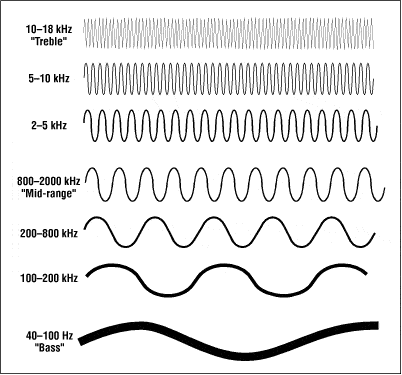
The human ear detects these sound waves and interprets them based on their frequency and amplitude. Frequency, measured in hertz (Hz), determines the pitch—higher frequencies create higher-pitched sounds, while lower frequencies create deeper tones.
Amplitude refers to the wave’s height and determines the loudness—greater amplitude means a louder sound.
Sound plays an essential role in communication, navigation, entertainment, and survival. Animals use it to warn of danger or attract mates, and humans rely on it for everything from language to music.
How Sound Waves Are Created
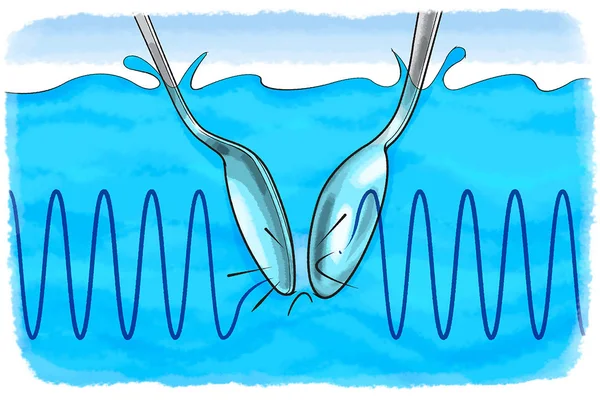
Sound waves are created when an object vibrates, causing the surrounding medium—usually air—to move in a pattern of compressions and rarefactions.
This begins with a disturbance, such as a guitar string being plucked, a drum being struck, or vocal cords vibrating during speech.
These vibrations push against nearby air molecules, causing them to compress (come together) and then rarefy (spread apart), forming a longitudinal wave.
In a longitudinal sound wave, the particles of the medium vibrate back and forth in the same direction the wave is moving.
This movement transmits energy through the medium. Unlike transverse waves—like water waves, where particles move up and down—sound waves rely on these alternating high-pressure (compression) and low-pressure (rarefaction) zones to propagate.
As the object continues to vibrate, it creates a chain reaction. One layer of air molecules pushes on the next, and the energy moves outward in waves. If the vibrations are fast and regular, we perceive a clear tone; if they are irregular, we might hear noise.
The frequency of these vibrations determines the pitch of the sound. Faster vibrations (more waves per second) create higher-pitched sounds, while slower vibrations produce lower-pitched ones. The amplitude, or strength of the vibrations, determines the loudness. Stronger vibrations move air molecules more forcefully, creating louder sounds.
This process isn’t limited to air. The same principle applies in liquids and solids, though the speed and efficiency of the wave differ depending on the medium’s density and elasticity.
How Sound Travels Through Different Mediums
Sound needs a medium—such as air, water, or solid materials—to travel. It cannot move through a vacuum, because sound is a mechanical wave that requires particles to transmit vibrations. However, the way sound travels—and how fast it travels—varies greatly depending on the type of medium it moves through.
In gases like air, sound travels relatively slowly. This is because gas molecules are far apart and take more time to transfer energy from one particle to another.
At room temperature, sound moves through air at about 343 meters per second (1,125 feet per second). This is the typical speed we experience when hearing someone speak or a car honking nearby.
In liquids, sound moves faster because the molecules are more tightly packed than in gases. For instance, sound travels through water at roughly 1,480 meters per second (4,860 feet per second)—over four times faster than in air. This explains how whales and dolphins can communicate across vast distances in the ocean.
Sound travels fastest in solids, where molecules are tightly bonded and can transfer vibrations more efficiently. For example, sound can travel through steel at around 5,960 meters per second (19,500 feet per second). This is why putting your ear to a train track can let you hear a distant train before you see it.
The density and elasticity of the material also affect sound’s speed and clarity. Denser materials tend to transmit sound more slowly, while more elastic materials—those that return quickly to their original shape after deformation—allow for faster sound transmission.
The Role of Vibrations in Sound Transmission
Vibrations are the foundation of all sound. Every sound we hear begins with something vibrating—whether it’s vocal cords, a guitar string, or a speaker cone.
These vibrations cause nearby particles in the surrounding medium (air, water, or solid material) to move. This movement then transfers energy from one particle to the next, creating sound waves that travel through the medium until they reach our ears.
In a typical sound wave, particles don’t move along with the wave but instead vibrate back and forth in place. This creates alternating areas of compression (where particles are pushed together) and rarefaction (where particles are spread apart). These pressure changes are what make up a longitudinal wave, the most common type of sound wave in air and fluids.
The strength or amplitude of the vibration affects how loud the sound is. Stronger vibrations cause more significant compressions and rarefactions, resulting in louder sounds. The frequency of the vibrations determines the pitch—faster vibrations produce higher-pitched sounds, while slower ones create lower pitches.
Different materials transmit vibrations differently. In solids, particles are closely packed, so vibrations move quickly and efficiently, making sound travel faster. In gases, like air, particles are further apart, and vibrations take more time to transfer between them, slowing down the sound.
Our own ears rely on vibration to hear. When sound waves enter the ear, they cause the eardrum to vibrate. These vibrations are passed through small bones and fluid-filled chambers before being converted into nerve signals the brain can understand.
Sound in Air vs. Water vs. Solids
Sound can travel through air, water, and solids, but it behaves differently in each medium due to the way particles are arranged. The speed, clarity, and intensity of sound all depend on how easily vibrations can move from one particle to the next.
In air, which is a gas, sound travels the slowest—about 343 meters per second (1,125 feet per second) at room temperature.
That’s because gas molecules are spread far apart, making it harder for them to collide and pass on vibrations. This is the reason why sound in air can seem faint or delayed over long distances.
In water, sound travels much faster—around 1,480 meters per second (4,860 feet per second). Water molecules are more tightly packed than air molecules, so they transmit vibrations more quickly.
This is why marine animals like dolphins and whales can communicate over long distances underwater. However, sound in water may not always be as clear to human ears because our hearing is adapted to air transmission.
In solids, sound travels the fastest. For example, in steel, it can reach speeds of 5,960 meters per second (19,500 feet per second). This is because solid particles are packed very tightly and are more rigid, allowing vibrations to transfer almost instantly.
You can experience this by placing your ear on a metal railing or train track—you’ll often hear a distant sound long before it reaches you through the air.
These differences highlight how particle density and bonding affect sound transmission. While air is the most common medium we hear sound through, both water and solids offer faster and sometimes more powerful ways for sound to travel.
Real-World Examples of Sound in Motion
Sound is constantly moving around us, and real-world examples help illustrate how it behaves in different environments.
One of the most familiar examples is hearing thunder after a lightning strike. Although the lightning flash and thunder occur simultaneously, light travels faster than sound, so you see the flash before you hear the rumble. The delay between the two helps estimate how far away the storm is.
Another everyday example is hearing a train through the rails before it’s visible. Because sound travels faster and more efficiently through solid steel than through air, placing your ear to a track lets you hear an oncoming train from much farther away than by sound alone in the air.
In water, divers can hear boat motors or marine animals from a long distance, often with surprising clarity. This is due to the high speed of sound transmission in water, where vibrations travel over four times faster than in air.
However, locating the source of a sound is more difficult underwater because the human ear relies on sound delays between the two ears—something that changes in a denser medium like water.
In buildings, knocking on a wall or tapping on a pipe transmits sound through solid materials, allowing people in other rooms or floors to hear the noise even if it’s faint through the air. This demonstrates how well sound travels through connected solid structures.
Even in entertainment, surround sound systems use carefully timed and directed sound waves to create immersive audio environments. Sound waves are manipulated to give the illusion of movement, making a movie or game feel lifelike.
Conclusion
Sound is all around us—yet we often take it for granted. At its core, sound is simply vibration moving through a medium, whether it’s the air we breathe, the water we swim in, or the solid ground beneath our feet.
From the buzz of a bee to the roar of a jet engine, every sound we hear begins with a source creating vibrations that ripple outward in waves.
Understanding how sound travels through different mediums—air, water, and solids—reveals just how dynamic and complex this everyday phenomenon really is.
In air, sound is slower and softer, while in water it moves faster but behaves differently to our ears. In solids, sound is incredibly fast and can travel long distances with surprising clarity.
Key to all of this are vibrations and particle interactions. These microscopic movements carry energy across space, enabling us to hear, communicate, and even feel the world around us. From thunder echoing across a canyon to music filling a concert hall, the principles of sound transmission remain the same.
Real-world examples—from underwater communication to the way sound travels through buildings—showcase how important the medium and environment are in shaping what we hear. They also help us better appreciate sound’s role in science, technology, medicine, and art.
In the end, sound is more than just noise. It’s a fundamental force that connects people, signals danger, expresses emotion, and fills our lives with meaning.
Whether you’re a curious student, an engineer, or just someone who loves music, understanding how sound travels helps you appreciate the invisible waves that bring the world to life—one vibration at a time.
