


Is Nether Travel 8 Blocks Real? It’s one of the most frequently asked questions in the Minecraft community—and for good reason.
The idea that moving just 1 block in the Nether allows you to travel 8 blocks in the Overworld sounds almost too good to be true.
But this isn’t just a rumor—it’s actually a core game mechanic built into Minecraft, and understanding how it works can completely transform how you explore and build in the game.
The basic rule is simple: 1 block traveled in the Nether equals 8 blocks traveled in the Overworld.
This is because of the coordinate scaling between the two dimensions. When you build and link portals correctly, you can use the Nether as a shortcut to cross vast distances in the Overworld in a fraction of the time.
For example, if you place a Nether portal at coordinates (100, 64, 100) in the Overworld, the corresponding location in the Nether will be (12.5, 64, 12.5), since each coordinate is divided by 8.
This ratio allows players to create fast-travel systems between bases, villages, and biomes that would otherwise take ages to reach.
However, there are important rules and limitations to keep in mind. Portals must be properly linked to avoid generating random new ones. You also need to factor in terrain, portal spacing, and the Y-axis when building efficient travel networks.
What the 8 Blocks Rule Means in Minecraft
In Minecraft, the 8 blocks rule refers to how distance is scaled between the Overworld and the Nether dimensions.
Specifically, every 1 block you move in the Nether is equal to 8 blocks in the Overworld. This 1:8 ratio is built into the game’s mechanics and is most noticeable when linking Nether portals for fast travel.
Here’s what it means in practice: if you travel 100 blocks in the Nether and build a portal, you’ll appear approximately 800 blocks away from your original portal in the Overworld.
This mechanic allows players to create incredibly efficient travel systems, skipping long and dangerous Overworld treks by using much shorter Nether paths.
The game achieves this by converting your Nether coordinates into Overworld coordinates (and vice versa) by multiplying or dividing by 8.
However, for the system to work correctly, portals must be placed carefully—incorrect positioning can cause new, unlinked portals to generate, which can ruin your network.
Understanding this rule is the foundation of advanced Minecraft transportation, especially for players managing farms, villages, or multiple bases across large distances.
How Nether Portals Affect Travel Distance
Nether portals are the key to unlocking Minecraft’s fast-travel system. When you enter a portal in the Overworld, the game calculates the corresponding location in the Nether by dividing your X and Z coordinates by 8.
This creates a direct link between the two dimensions using the 1:8 travel ratio—meaning every block moved in the Nether equals 8 blocks in the Overworld.
For example, a portal at Overworld coordinates (800, 64, 0) links to a Nether portal near (100, 64, 0). If you then walk 100 blocks in the Nether and build a new portal, it could take you to (1600, 64, 0) in the Overworld—effectively letting you travel 1,600 blocks in seconds.
However, distance isn’t the only factor. The game tries to find an existing portal near the calculated spot, which can cause unintended connections if portals are too close together or not aligned properly.
To maintain control, you should manually link portals by calculating coordinates and ensuring each Nether portal leads exactly where you want in the Overworld.
By mastering portal placement and understanding this dimensional scaling, you can build highly efficient transportation systems across your Minecraft world.
The Math Behind 8 Blocks = 64 Blocks
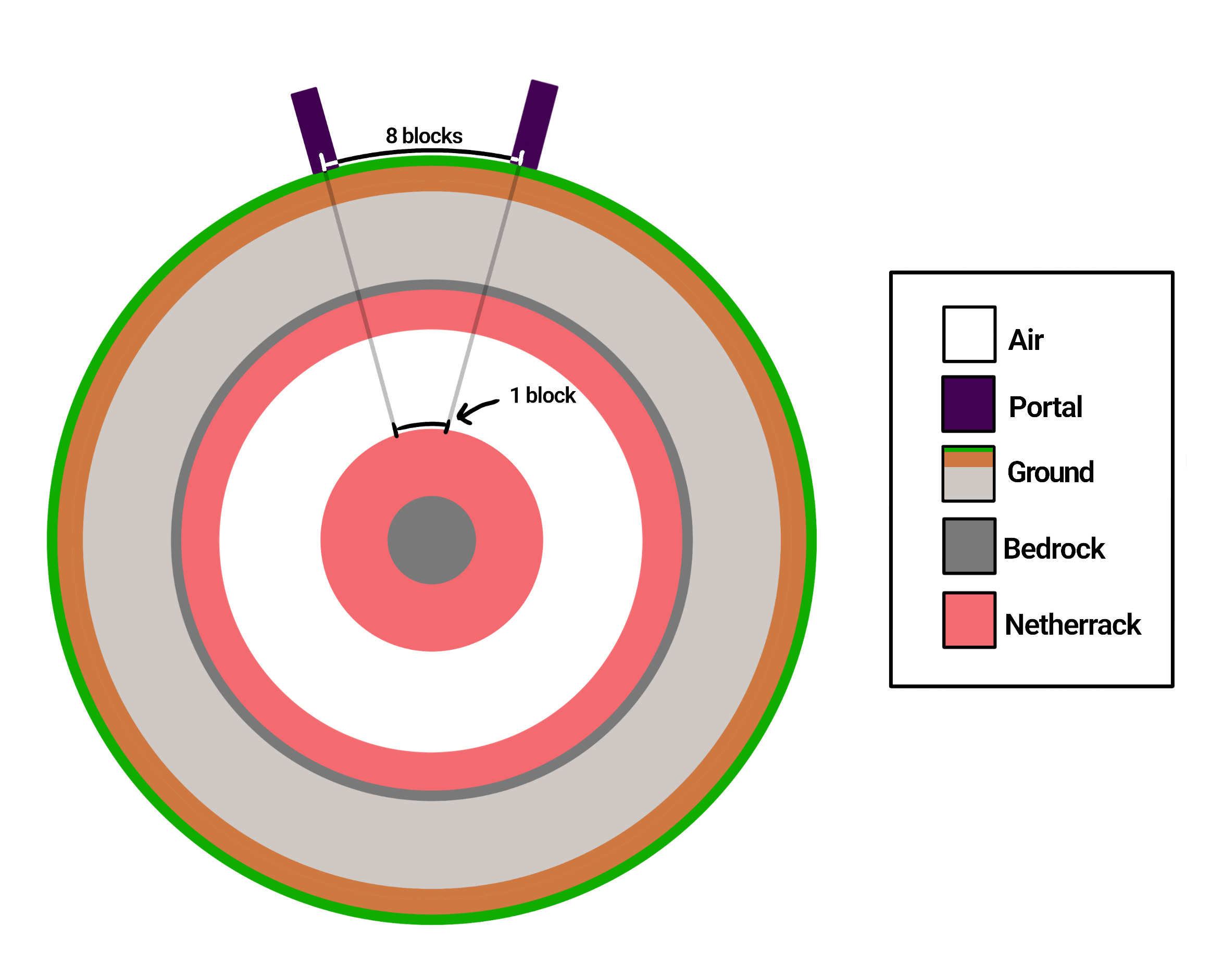
The phrase “8 blocks = 64 blocks” in Minecraft refers to how travel distance is scaled between the Nether and the Overworld.
The game uses a fixed ratio: 1 block in the Nether equals 8 blocks in the Overworld along the X and Z axes (horizontal movement).
So, if you move 8 blocks in the Nether and then build a portal, the new Overworld portal will be generated approximately 64 blocks from the original Overworld portal. Here’s the math:
- Overworld to Nether:
Divide your X and Z coordinates by 8.
Example: (800, 64, 0) in Overworld → (100, 64, 0) in Nether - Nether to Overworld:
Multiply your X and Z coordinates by 8.
Example: (100, 64, 0) in Nether → (800, 64, 0) in Overworld
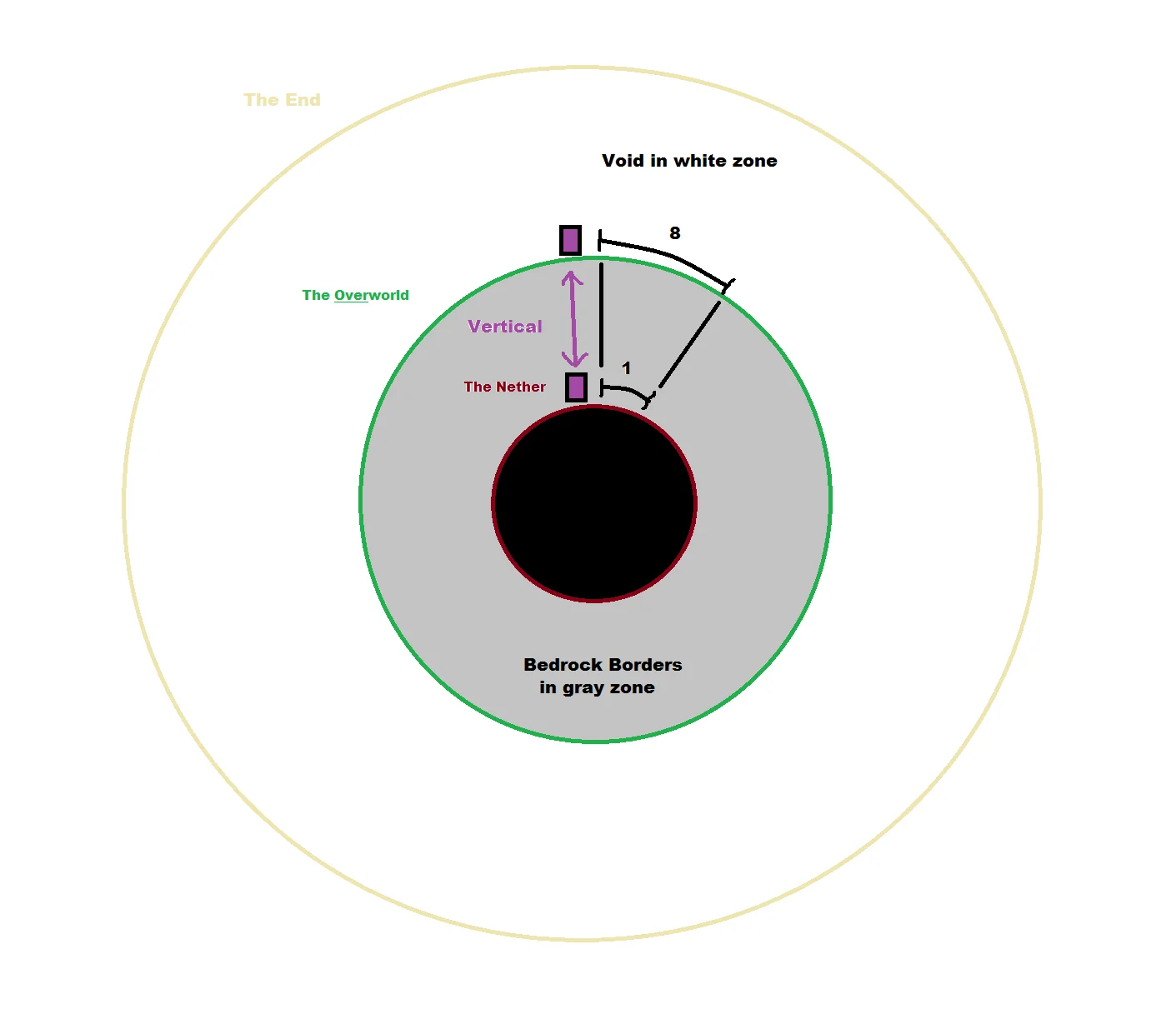
This scaling allows players to use the Nether as a shortcut dimension, saving huge amounts of travel time. However, note that the Y-axis (vertical) does not scale—only X and Z are affected.
Using this math, you can strategically place portals to create fast-travel systems across biomes, villages, or player bases, all with precise control.
Common Misconceptions About Nether Travel
While the 1:8 Nether travel rule is a powerful mechanic in Minecraft, many players misunderstand how it actually works. Here are some of the most common misconceptions:
“Portals Always Link Automatically”
Many believe that simply building two portals in the right coordinates will link perfectly. In reality, portal linking is based on proximity—if an existing portal is nearby (within 128 blocks in the Overworld), the game may connect to that one instead, even if it’s not precisely aligned.
“The Y-Axis Scales Too”
Only the X and Z coordinates (horizontal movement) follow the 1:8 ratio. The Y-axis (height) does not scale between dimensions. This can affect portal placement, especially in vertical builds like mountain bases or deep caves.
“You Can Place Portals Anywhere and They’ll Work”
While portals can be placed freely, linking them properly requires manual coordinate calculations. Random placement often results in unlinked or misaligned portals.
“You Can Use the Nether Instantly for Fast Travel”
To benefit from Nether travel, players need to build and test a portal network, especially in multiplayer worlds. Without planning, it’s easy to get lost or misrouted.
When the 8 Blocks Rule Doesn’t Work
While the 1:8 Nether-to-Overworld travel ratio is a core Minecraft mechanic, it doesn’t always behave perfectly—especially if portals aren’t carefully aligned. Here are key situations where the 8 blocks rule seems to “break”:
- Portals Link to the Wrong Location
If a new portal is placed too close to an existing one (within about 128 blocks in the Overworld), Minecraft may link it to the wrong destination, ignoring the exact 1:8 coordinate mapping. This is because the game prioritizes proximity over mathematical accuracy. - Vertical Misalignment (Y-axis Issues)
The 1:8 ratio only applies to X and Z coordinates. The Y-axis (height) is not scaled, and extreme elevation differences can prevent portals from linking correctly—even if X and Z are accurate. - Auto-Generated Portals
When a player enters a Nether portal without a correctly placed counterpart on the other side, Minecraft may generate a new portal at the nearest suitable terrain. This can create the illusion that the 8-block rule failed. - Chunk Loading & Portal Conflicts
In multiplayer or complex worlds, chunk loading issues or overlapping portal systems can disrupt portal behavior, breaking the expected travel logic.
Mastering Nether travel can save you hours in Minecraft, but efficiency requires more than just knowing the 1:8 rule.
Here are some pro tips to make your Nether navigation smooth and reliable:
Plan Your Portal Coordinates Carefully
Always calculate your Nether portal coordinates by dividing Overworld X and Z by 8 before building. This ensures portals link correctly without creating unwanted ones.
Build Safe Paths
The Nether is full of lava, fire, and hostile mobs. Build enclosed, well-lit corridors to protect yourself during travel. Consider using materials like cobblestone that resist Ghast explosions.
Use Landmarks and Signs
Because the Nether can be confusing and maze-like, place signs or unique blocks to mark your routes and portal locations for easy navigation.
Carry Essentials
Bring plenty of food, blocks for bridging, fire resistance potions, and a strong weapon to handle unexpected dangers.
Use Coordinates and Maps
Keep track of your position using the F3 debug screen (Java Edition) or a map. Knowing your exact coordinates helps you avoid getting lost.
Connect Bases with Portal Networks
Create a network of portals spaced properly to cover large distances quickly. This is especially helpful for multiplayer servers or huge worlds.
Conclusion
Nether travel and the famous 1:8 ratio are very much real—and they’re one of Minecraft’s most useful mechanics for fast and efficient exploration.
By understanding how the Nether’s coordinates relate to the Overworld, you can build strategic portal networks that save time and unlock new possibilities for your gameplay.
However, mastering this mechanic requires careful portal placement and a bit of planning. Misaligned portals or ignoring the Y-axis differences can lead to confusing or failed connections. Knowing when and why the 8 blocks rule doesn’t work helps you troubleshoot problems and optimize your travel system.
Whether you’re a casual player or a seasoned builder, using the Nether for fast travel can greatly improve your Minecraft experience.
Take the time to learn the math, build safe pathways, and plan your portals, and you’ll be zipping across your world in no time.
