

Literary term for point of view refers to the perspective from which a story is told.
This crucial narrative technique shapes how readers experience events, characters, and emotions. Understanding point of view (POV) helps writers craft compelling stories and allows readers to analyze texts more deeply.
What Is the Literary Term for Point of View?
The literary term for point of view defines who narrates the story and how much they know. It influences:
- Reader engagement – How close audiences feel to characters.
- Unreliability – Whether the narrator can be trusted.
- Information control – What details are revealed or hidden.
Key Elements of Point of View
- Narrator’s position (inside or outside the story).
- Pronouns used (I, you, he/she/they).
- Knowledge level (omniscient vs. limited).
Literary Term for Point of View in Literature
Authors choose POV strategically to enhance themes and character development.
Famous Examples
- First-Person (To Kill a Mockingbird) – Scout’s childlike perspective shapes racial injustice themes.
- Third-Person Limited (Harry Potter) – Readers discover magic alongside Harry.
- Omniscient (Pride and Prejudice) – Austen reveals multiple characters’ private thoughts.
Why It Matters: POV determines emotional depth and narrative scope.
Literary Term for Point of View Examples
First-Person POV
- “I knew I shouldn’t have gone to the party.”
- Effect: Creates intimacy; narrator may be unreliable.
Second-Person POV
- “You walk into the room and see a body.”
- Effect: Rare but immersive (used in choose-your-own-adventure stories).
Third-Person Limited
- “She wondered if he’d ever forgive her.”
- Effect: Focuses on one character’s inner world.
Third-Person Omniscient
- “John hated the lie, but Mary believed it completely.”
- Effect: Reveals multiple perspectives.
Literary Term for Point of View in Writing
Writers select POV based on:
- Genre conventions (e.g., romance often uses first-person).
- Thematic goals (e.g., omniscient for societal critiques).
- Character complexity (e.g., unreliable narrators in thrillers).
Pro Tip: Stick to one POV per scene to avoid confusion.
Literary Term for Point of View Definition
POV is formally defined as:
“The narrative voice through which a story is presented.”
Key Aspects:
- Grammatical person (I/you/he).
- Knowledge scope (limited vs. all-knowing).
- Subjectivity (biased vs. neutral).
Literary Term for Point of View in Storytelling

How POV Shapes Stories
- Suspense – Limited POV hides information (e.g., mystery novels).
- Empathy – First-person builds character connection.
- Objectivity – Third-person omniscient provides broader insights.
Example: Gone Girl uses dual first-person POV to mislead readers.
Literary Term for Point of View in Novels
Popular Novel POVs
| POV Type | Example Novel | Effect |
| First-Person | The Catcher in the Rye | Raw, confessional tone |
| Third-Limited | The Hunger Games | Reader aligns with Katniss |
| Omniscient | Middlemarch | Expansive social commentary |
Trend: Contemporary YA often uses first-person present tense for immediacy.
Literary Term for Point of View in Poetry
Poets use POV to:
- Create persona (e.g., Sylvia Plath’s “Daddy” as confessional).
- Shift perspectives (e.g., “The Love Song of J. Alfred Prufrock”).
Key Technique: Dramatic monologue (first-person persona poems).
Literary Term for Point of View and Perspective
POV vs. Perspective
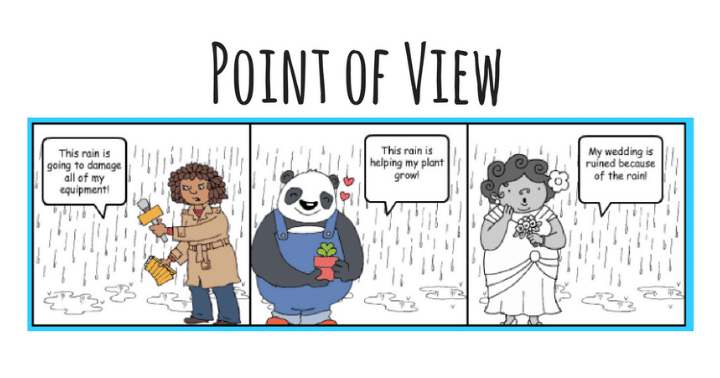
- POV: Who tells the story (technical choice).
- Perspective: How the narrator sees the world (worldview, biases).
Example: In The Great Gatsby, Nick’s first-person POV is filtered through his judgmental perspective.
Literary Term for Point of View for Students
Study Tips
- Identify pronouns to determine POV.
- Note knowledge limits – Does the narrator know all characters’ thoughts?
- Analyze effects – How does POV influence themes?
Classic Exercise: Rewrite a scene in a different POV and compare impacts.
Literary Term for Point of View in Narration
Unreliable Narration
Some narrators distort the truth, often in:
- First-person (e.g., Lolita’s Humbert Humbert).
- Stream-of-consciousness (e.g., Mrs. Dalloway).
Red Flags: Contradictions, biased language, gaps in memory.
Literary Term for Point of View Types
The 4 Main POV Types
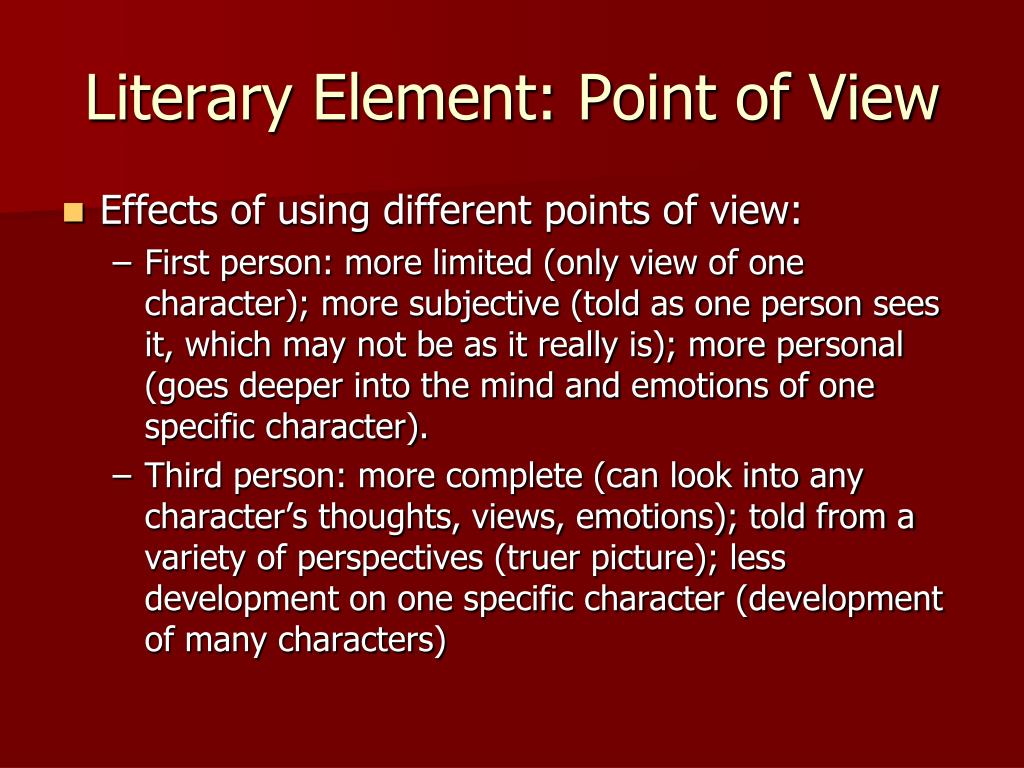
- First-Person
- “I” narrator.
- Pros: Intimate; Cons: Limited scope.
- Second-Person
- “You” protagonist.
- Pros: Immersive; Cons: Hard to sustain.
- Third-Person Limited
- “He/She” with one character’s thoughts.
- Pros: Balanced; Cons: Less personal.
- Third-Person Omniscient
- “He/She” with all characters’ thoughts.
- Pros: Expansive; Cons: Can feel detached.
Literary Term for Point of View in Fiction
Genre-Specific POVs
- Mystery/Thriller: First-person for suspense.
- Epic Fantasy: Omniscient for worldbuilding.
- Romance: Dual first-person for both leads’ emotions.
Trend: Deep third-person limited (close psychic distance) is rising.
Literary Term for Point of View in Drama
Plays use:
- Dialogue (no narrator; POV is implied).
- Soliloquies (first-person insights).
- Chorus (collective omniscient voice, e.g., Greek tragedies).
Example: Macbeth’s soliloquies reveal his first-person guilt.
Literary Term for Point of View in Prose
POV Shifts
Rare but powerful when done intentionally (e.g., As I Lay Dying’s multi-narrator structure).
Rule: Always signal shifts clearly (e.g., chapter breaks).
Literary Term for Point of View Explained
Why POV Choices Matter
- First-person: Builds empathy but limits objectivity.
- Third-limited: Balances immersion and flexibility.
- Omniscient: Offers godlike overview but risks emotional distance.
Classic Case Study: Jane Eyre’s first-person POV amplifies its feminist themes.
FAQs About Literary Term for Point of View
1. What’s the most common POV in fiction?
Third-person limited, followed by first-person.
2. Can POV change within a story?
Yes, but abrupt shifts confuse readers. Use clear section breaks.
3. What’s “head-hopping”?
Accidental POV shifts within a scene (e.g., suddenly revealing another character’s thoughts in third-limited).
4. Why use second-person POV?
For experimental or interactive fiction (e.g., Bright Lights, Big City).
5. How does POV affect theme?
It filters what readers know, shaping their moral judgments (e.g., Lolita’s manipulative narrator).
6. What’s “free indirect discourse”?
A third-person style that blends a character’s thoughts with narration (e.g., “She was late—typical!”).
7. Can poetry have multiple POVs?
Yes! See The Waste Land for shifting voices.
Conclusion on Literary Term for Point of View
Mastering the literary term for point of view empowers writers to control reader experience and helps readers decode narrative techniques.
Whether you’re analyzing To Kill a Mockingbird or crafting your novel, understanding POV is essential to powerful storytelling. Experiment with perspectives to find your unique voice!
