



Solecism is a fascinating yet often misunderstood concept in the world of language and communication. It refers to a grammatical mistake, a deviation from conventional rules, or an incorrect usage in speech or writing. Understanding the meaning of solecism is essential for anyone who values precise and effective communication.
While the term often applies to grammatical errors, it can also encompass awkward phrasing, incorrect idioms, and misuse of vocabulary. Such mistakes may arise from a lack of knowledge, carelessness, or the influence of regional dialects. Interestingly, solecism in grammar has been studied for centuries, highlighting the importance of linguistic accuracy in literature, academic writing, and everyday conversation.
Meaning of Solecism
The meaning of solecism extends beyond simply calling something a grammar mistake. In its strictest sense, it refers to a violation of the grammatical structure of a language. This can include misusing verb tenses, incorrect subject-verb agreement, or improper sentence construction. For example, saying “She don’t like ice cream” instead of “She doesn’t like ice cream” is a direct grammatical error and, therefore, a solecism.
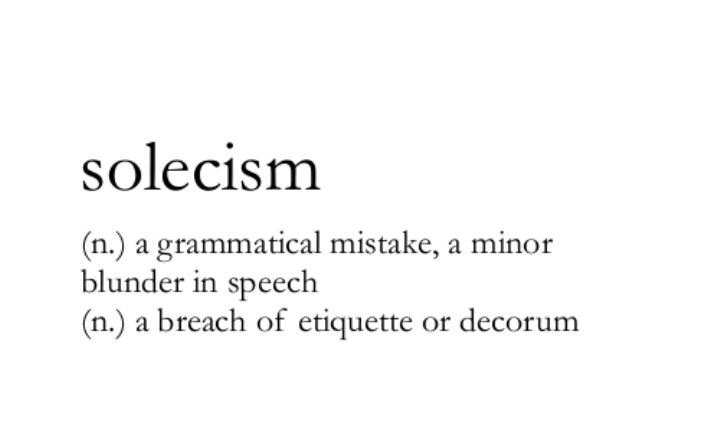

The term can also apply to misapplied idioms or syntactic choices that make a sentence sound unnatural. The key difference between grammatical errors and general language mistakes lies in the structure—while any error might break a rule, a solecism specifically violates the syntax or accepted grammatical order of a language.
In rhetorical discussions, the term is often contrasted with stylistic errors, which may be intentional for artistic effect. By knowing the solecism definition and usage, language learners can identify these deviations and work towards more accurate expression.
Solecism in Grammar
Solecism in grammar specifically addresses mistakes related to sentence structure and syntax. Grammar provides the framework for how words and phrases should be organized to convey meaning correctly.
When that framework is broken, the result is a solecism. This could be as minor as a missing article or as significant as a completely jumbled sentence order. Examples include mixing singular and plural incorrectly, such as “Those kind of apples are tasty” instead of “That kind of apple is tasty”, or using the wrong tense, like “He go to school yesterday”.
These mistakes may occur due to lack of understanding, poor editing, or the influence of colloquial speech patterns. Teachers often highlight common solecisms in English to help students recognize and avoid them. The study of grammar makes it clear that solecisms can weaken credibility, confuse readers, and distort meaning, making it crucial to master correct forms in both spoken and written communication.
Common Solecisms in English
Common solecisms in English can be grouped into several categories, making them easier to identify and avoid. These include subject-verb agreement errors, misuse of pronouns, incorrect prepositions, and misplaced modifiers. Some frequent examples are:
- “Me and him went to the store” instead of “He and I went to the store”
- “Between you and I” instead of “Between you and me”
- “She is more prettier than her sister” instead of “She is prettier than her sister”
- “They was late” instead of “They were late”
Such errors are not limited to casual speech—they often appear in professional writing when attention to detail slips. Many grammatical errors result from regional influences, translation issues, or misunderstanding of idiomatic structures.
Recognizing these patterns helps speakers and writers maintain accuracy. Avoiding solecisms isn’t about being overly formal—it’s about ensuring clarity and respect for language norms. Mastery comes from exposure, practice, and continual review of one’s own writing.
Examples of Solecism
The examples of solecism illustrate just how common these mistakes can be in everyday communication. They can appear in spoken conversation, formal writing, and even in media scripts. Consider these situations:
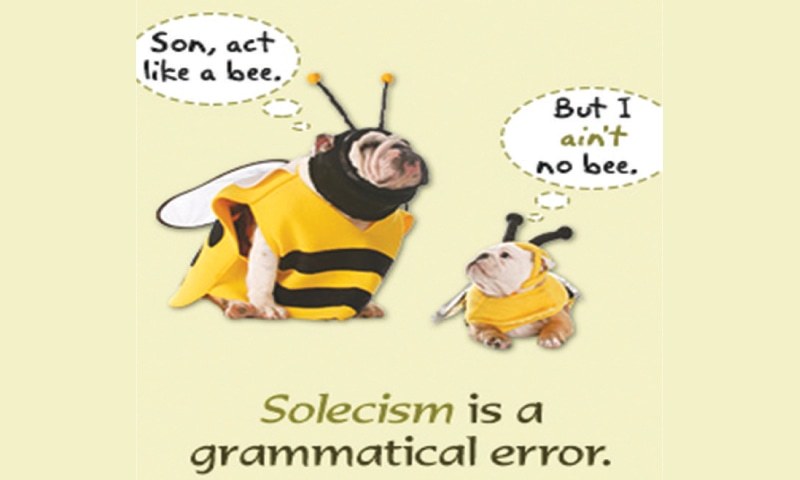
- “She ain’t got no money” – Double negative and incorrect verb use.
- “Where you at?” – Unnecessary preposition.
- “I seen him yesterday” – Incorrect past tense form.
- “That’s a whole nother story” – Nonstandard word formation.
- “They was going to the park” – Subject-verb disagreement.
To further clarify, here’s a quick table:
| Incorrect Usage | Correct Form |
| Me and her are friends | She and I are friends |
| He don’t like movies | He doesn’t like movies |
| Between you and I | Between you and me |
| I done my homework | I did my homework |
These language mistakes highlight the importance of grammatical discipline. Whether in professional settings or casual conversations, avoiding solecisms enhances credibility and prevents misunderstandings.
Solecism Pronunciation
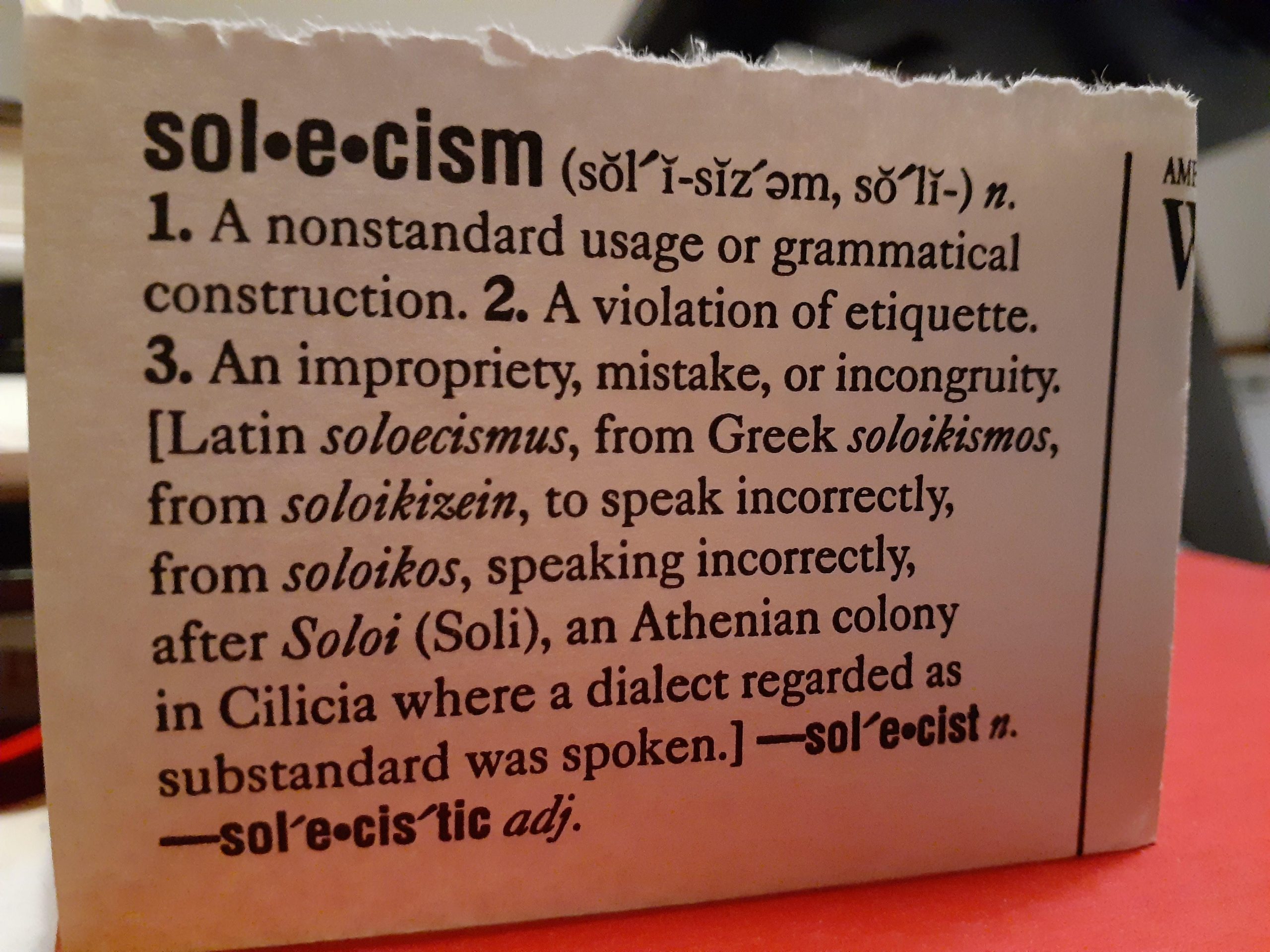

The solecism pronunciation follows standard English phonetics: /ˈsɒl.ɪ.sɪz.əm/ in British English and /ˈsoʊ.ləˌsɪz.əm/ in American English. The stress falls on the first syllable, making it sound like “SOL-ih-siz-um” or “SOH-luh-siz-um.”
Understanding pronunciation is vital for effective verbal communication, especially in academic or professional contexts where using the term incorrectly might undermine your credibility. Pronouncing it correctly ensures clarity when discussing linguistic topics and prevents confusion with similar-sounding words.
While many people focus solely on its definition, proper articulation contributes to overall language mastery. A clear pronunciation reinforces the speaker’s authority on the subject and encourages accurate usage among listeners. In linguistic education, instructors often pair pronunciation lessons with the origin of the word solecism to help students remember both sound and meaning.
Difference Between Solecism and Faux Pas
A solecism and a faux pas both represent mistakes, but they occur in different spheres. While a solecism is a grammatical error or violation of language structure, a faux pas refers to a social blunder or breach of etiquette. For example, misusing verb tense is a solecism, while wearing inappropriate attire to a formal event is a faux pas. The table below clarifies the distinction:
| Feature | Solecism | Faux Pas |
| Nature of Mistake | Language or grammar-based | Social or etiquette-based |
| Example | “He don’t know nothing” | Interrupting someone during a toast |
| Context | Speech, writing, communication rules | Social gatherings, cultural norms |
| Consequence | Misunderstanding, reduced credibility | Embarrassment, offending others |
Understanding the difference between solecism and faux pas helps individuals improve both their language use and social interactions. Both can damage perception, but in distinct ways.
Solecism Definition and Usage
The solecism definition and usage have evolved since its historical beginnings. In classical rhetoric, a solecism was any deviation from standard grammar in Greek or Latin.
Today, it is used broadly to describe errors in any language. Its usage spans academic discourse, linguistic criticism, and even casual conversation when pointing out language inaccuracies. Writers, educators, and editors often employ the term to highlight problems in sentence construction, particularly when the error changes the meaning or reduces clarity.
In literature, some authors use deliberate solecisms to reflect a character’s social background or speech style. This creative usage demonstrates how the definition can shift depending on context. By recognizing the varied uses of solecism in grammar, one can appreciate its role not just as a warning against errors, but also as a tool for stylistic choice.
Origin of the Word Solecism
The origin of the word solecism traces back to Ancient Greece. It comes from the Greek word “soloikismos,” named after the inhabitants of Soloi, a city in Cilicia. The residents were said to speak Greek incorrectly, influenced by their native dialect, leading Athenians to label such errors as “soloikismos.”
Over time, the Latin “soloecismus” entered scholarly vocabulary, eventually passing into English in the 16th century.
The historical background reflects how closely language is tied to social perception and identity. Early usage focused on errors in classical languages, but as English grammar rules developed, the term gained broader application. This rich history shows that solecism has always been a marker of linguistic deviation, whether due to regional influence, incomplete mastery, or deliberate stylistic choice.

FAQs about Solecism
What is the meaning of solecism?
It refers to a grammatical mistake or incorrect usage in speech or writing, violating language rules.
Can solecism be intentional?
Yes, authors sometimes use it deliberately for stylistic or character-driven purposes in literature.
What are common solecisms in English?
Examples include subject-verb agreement errors, wrong pronoun cases, and double negatives.
How is solecism pronounced?
In British English: /ˈsɒl.ɪ.sɪz.əm/; in American English: /ˈsoʊ.ləˌsɪz.əm/.
Is solecism the same as a typo?
No, a typo is a mechanical error in writing, while a solecism is a grammatical mistake.
What is the difference between solecism and faux pas?
Solecism is a language error, while faux pas is a social blunder.
Where did the term solecism come from?
It originated from the Greek “soloikismos,” named after the city of Soloi.
Conclusion of Solecism
The study of solecism reveals its deep linguistic and historical roots. From its origin in Ancient Greece to its role in modern grammar instruction, it stands as a reminder of the importance of accuracy in language. Recognizing examples of solecism helps us avoid common pitfalls and improves both written and spoken communication.
While solecism in grammar may sometimes be deliberate for artistic reasons, unintentional mistakes can harm clarity and credibility. Understanding the difference between solecism and faux pas also enriches one’s communication skills beyond grammar, extending into social awareness. Whether you are a language learner, educator, or professional writer, mastering the nuances of this concept ensures that your speech and writing remain precise, polished, and powerful.


