




Imagine you have 10 white socks and 6 black socks in a drawer. You reach in without looking and start pulling out socks. What is the minimum number of socks you must take to guarantee a matching pair? 🤔
At first, you might think the answer is 2—after all, there are only two colors. However, there’s a chance that you pick one white sock and one black sock, meaning they don’t match. To guarantee a matching pair, you need to consider the worst-case scenario.
If you pick two socks, they could still be different colors (one black, one white). But if you pick three socks, at least two of them must be the same color—either both white or both black.
This is based on the pigeonhole principle, which states that if you place more objects into fewer categories, at least one category must contain more than one object.
✅ Answer: You must pick 3 socks
No matter what, three socks will always include a matching pair! 🎯
Breaking It Down: Understanding the Sock Dilemma

At first glance, the 10 white socks and 6 black socks riddle might seem simple. After all, there are only two colors—how hard could it be? But when you’re blindly picking socks from a drawer, things get tricky.
The key is to consider the worst-case scenario. If you pick one sock, you obviously don’t have a pair yet. If you pick two socks, there’s a chance you get one white and one black—still no match.
To guarantee a matching pair, you need to grab three socks. Why? Because with only two colors available, at least two socks must be the same color.
This follows a simple math rule called the pigeonhole principle—if you place more objects into fewer categories, at least one category must contain more than one object.
So no matter what, by the time you pick three socks, you’ll always have at least one matching pair—either two white or two black.
The Probability Behind the Answer
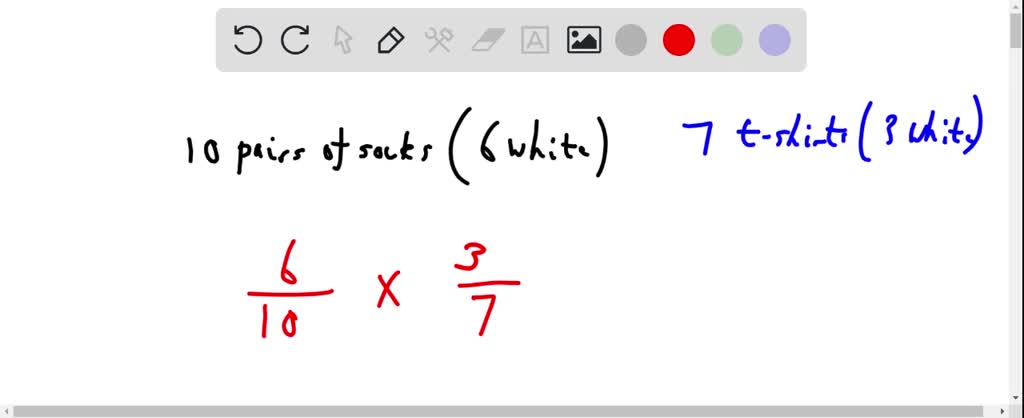

Let’s break down the probability of picking a matching pair when drawing socks at random from a drawer containing 10 white socks and 6 black socks.
Step 1: The Total Socks
You have 16 socks in total:
- 10 white 🧦
- 6 black 🖤
Step 2: Drawing the First Sock
The first sock you pick can be any color because it doesn’t determine a match yet.
Step 3: Drawing the Second Sock
Now, let’s calculate the probability of getting a matching pair on your second draw:
- If you picked white first (10/16 chance), the probability of picking another white sock is 9/15.
- If you picked black first (6/16 chance), the probability of picking another black sock is 5/15.
Using probability calculations:
P(matching pair in 2 draws)=P(white first)×P(white second)+P(black first)×P(black second)P(\text{matching pair in 2 draws}) = P(\text{white first}) \times P(\text{white second}) + P(\text{black first}) \times P(\text{black second})P(matching pair in 2 draws)=P(white first)×P(white second)+P(black first)×P(black second) =(1016×915)+(616×515)= \left(\frac{10}{16} \times \frac{9}{15}\right) + \left(\frac{6}{16} \times \frac{5}{15}\right)=(1610×159)+(166×155) =(90240)+(30240)=120240=50%= \left(\frac{90}{240}\right) + \left(\frac{30}{240}\right) = \frac{120}{240} = 50\%=(24090)+(24030)=240120=50%
Step 4: Guaranteeing a Match
Since there’s still a 50% chance of getting mismatched socks after two picks, we must take a third sock to guarantee a match. At this point, no matter what colors the first two socks were, the third one will always match at least one of them.
✅ Conclusion: The Minimum Number Is 3
By applying probability and logic, we see that picking three socks guarantees a matching pair every time.
The Pigeonhole Principle – Why It Works
The Pigeonhole Principle is a simple yet powerful concept in mathematics and logic. It states that if you have more objects than categories, at least one category must contain more than one object.
Applying It to the Sock Riddle
In our riddle, we have only two colors of socks—white and black—but we are picking multiple socks at random.
- The first sock can be any color.
- The second sock may or may not match the first.
- The third sock, however, must match at least one of the first two because there are only two possible colors.
Since we are placing three socks into just two color categories, one color must repeat—guaranteeing a match.
A Simple Real-World Example
Imagine you have two boxes and you start placing marbles into them. If you only have two marbles, you could place one in each box. But as soon as you add a third marble, one box must contain at least two marbles.
✅ Why It Works Every Time
No matter what colors your first two socks are, the third one must match one of them.
Common Mistakes People Make


The 10 white socks, 6 black socks riddle might seem straightforward, but many people fall into logical traps when trying to solve it. Here are some of the most common mistakes and misunderstandings:
1️⃣ Thinking Two Socks Are Enough
Many assume that picking two socks will always result in a matching pair. However, there’s a chance you pick one white and one black, leaving you without a match. This is why three socks are needed to guarantee a pair.
2️⃣ Overcomplicating the Probability
Some people try to calculate complex probabilities for each draw instead of recognizing the simple Pigeonhole Principle. Since there are only two colors, three picks are enough to force a match—no need for advanced math!
3️⃣ Ignoring the Worst-Case Scenario
A common mistake is assuming the best-case scenario, where the first two socks match. But in logic puzzles, it’s essential to consider the worst case—which, in this case, is picking two different colors first.
4️⃣ Misunderstanding “Random Selection”
Some assume they can control which socks they pick, but the riddle specifically refers to random selection in the dark. This means there’s no way to intentionally grab a matching pair immediately.
The Correct Answer Explained
The riddle states that you have 10 white socks and 6 black socks in a drawer. The question is:
How many socks must you take to guarantee a matching pair?
Step 1: Understanding the Possibilities
Since there are only two colors of socks, each time you pull a sock, it will be either white or black.
- If you pick one sock, there’s no possibility of a pair yet.
- If you pick two socks, there’s a chance they don’t match (one white, one black).
- If you pick a third sock, no matter what color it is, it must match at least one of the first two.
Step 2: Applying the Pigeonhole Principle
The Pigeonhole Principle tells us that if we place three socks into only two possible color categories, at least one color must repeat—ensuring a matching pair.
Step 3: The Final Answer
💡 You need to pick at least 3 socks to guarantee a matching pair.


