

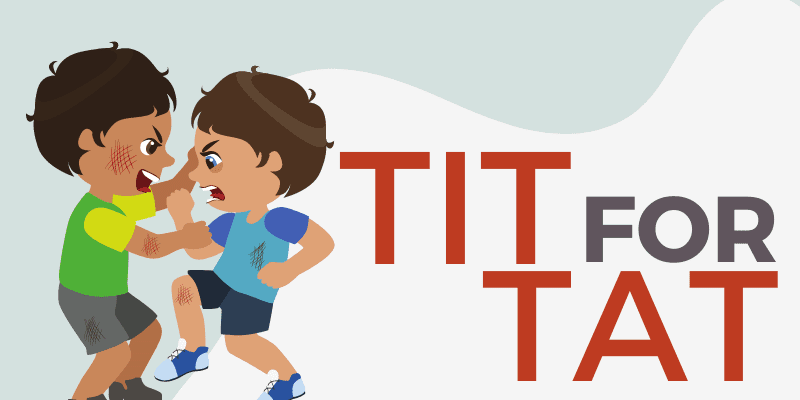
Tit for tat meaning encapsulates a fundamental concept in human interactions: responding to an action with an equivalent one.
This English phrase, rooted in centuries-old linguistic traditions, describes a reciprocal exchange where one party mirrors another’s behavior, whether cooperative or confrontational.
Often likened to “an eye for an eye” or a “tooth for a tooth,” tit for tat signifies a balanced response, ensuring fairness or retaliation. Its versatility shines in contexts like politics, games, and social dynamics, making it a cornerstone of strategic behavior.
Defining Tit for Tat Meaning in the English Language
The tit for tat meaning revolves around reciprocity, where an action prompts an equivalent given in return. According to the Oxford Dictionary, tit for tat is defined as “an equivalent blow or action in return for one received.”
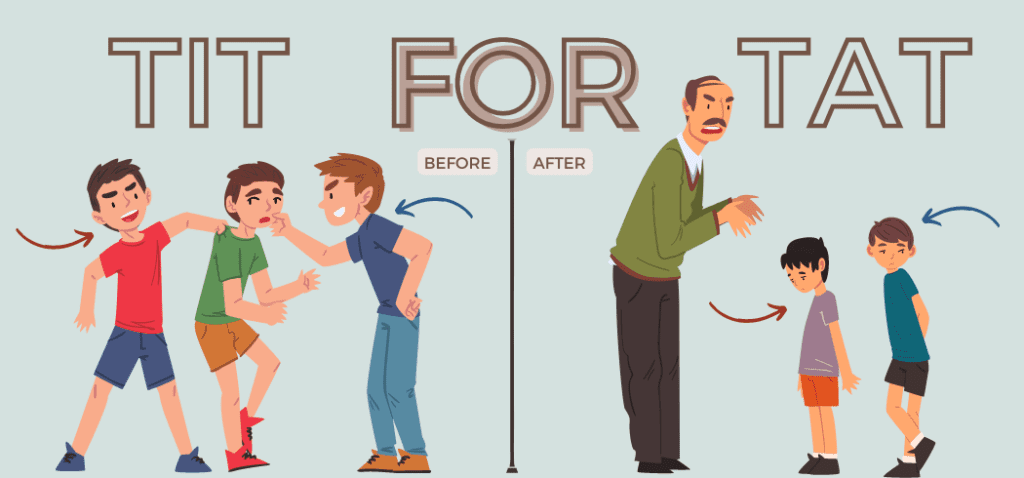
For example, if someone helps you, you might respond with a similar favor; if they harm you, you might retaliate with a comparable hit. This phrase captures both positive and negative exchanges, emphasizing fairness and balance in interactions.
Beyond its dictionary definition, tit for tat reflects a universal principle of justice. It’s often associated with the saying “blow for blow,” highlighting a direct, equal response. The meaning of tit for tat extends to everyday scenarios, from workplace exchanges to international disputes, where actions are met with proportionate reactions. Its simplicity and clarity make it a powerful expression in the English language, widely understood across cultures.
Where Did the Phrase Tit for Tat Originate?
The tit for tat meaning has historical roots dating back to the 16th century. Some scholars, as noted on Wikipedia, suggest it evolved from an older phrase, tip for tap, where “tip” and “tap” referred to light blows or strikes. This earlier expression likely described physical exchanges but gradually took on broader connotations of reciprocity. Over time, tit for tat became the standard form, cementing its place in English vernacular.
The phrase also draws parallels with ancient concepts like “an eye for an eye” or “a tooth for a tooth,” found in legal codes like the Code of Hammurabi. These ideas underscore the human instinct to respond with an equal measure, whether in justice or conflict. The word’s evolution reflects its enduring relevance, adapting to modern contexts while retaining its core meaning of tit for tat.
How Is Tit for Tat Used as a Strategy in Game Theory?
In game theory, tit for tat is a renowned strategy, particularly in the Prisoner’s Dilemma, where players choose to cooperate or defect. The tit for tat meaning here involves starting with cooperation and then mirroring the opponent’s previous move. If they cooperate, you cooperate; if they defect, you retaliate with a defection. This ensures an equivalent response, balancing trust and deterrence.
This strategy’s strength lies in its simplicity and effectiveness. It encourages cooperation by rewarding positive actions while discouraging betrayal through swift retaliation. In repeated games, tit for tat fosters mutual benefit, as players learn that their actions directly influence outcomes. However, it requires a context where interactions are ongoing, as a single move can trigger a cycle of blows.
What Are the Strengths and Weaknesses of Tit for Tat in Games?
The tit for tat meaning in game theory highlights both its advantages and limitations. Its strengths include:
- Promotes Cooperation: By mirroring positive actions, it builds trust.
- Deters Exploitation: Swift retaliation discourages harmful moves.
- Easy to Implement: Its straightforward rule—return like for like—is universally applicable.
However, it has weaknesses:
- Risk of Escalation: A single negative action can spiral into endless retaliation.
- Lack of Forgiveness: It may perpetuate conflict without a mechanism to break the cycle.
- Context Sensitivity: Effectiveness depends on the game’s structure and players’ intentions.
The table below compares tit for tat with other game theory strategies:
| Strategy | Description | Strengths | Weaknesses |
| Tit for Tat | Mirrors opponent’s last move | Encourages cooperation, simple | Can escalate conflict |
| Always Cooperate | Cooperates every round | Builds trust, avoids conflict | Easily exploited |
| Always Defect | Defects every round | Maximizes short-term gain | Destroys long-term cooperation |
| Grim Trigger | Cooperates until defection, then defects forever | Strong deterrent for defection | Unforgiving, escalates tensions |
This comparison underscores why tit for tat is a preferred strategy in balanced scenarios.
How Does Tit for Tat Meaning Apply to Everyday Human Interactions?
In daily life, the tit for tat meaning manifests in social exchanges where people respond to actions with equivalent ones. For instance, if a friend helps you move, you might return the favor by assisting them later. Conversely, if someone insults you, a tit-for-tat response might involve a sharp comeback. This behaviour reflects the phrase’s role in maintaining fairness in human relationships.

The expression is also prevalent in media, where it describes reciprocal actions in disputes or competitions. For example, in a workplace, if a colleague takes credit for your work, you might retaliate by highlighting their oversight. The tit for tat meaning here ensures accountability but can escalate tensions if not managed carefully.
What Are Similar Expressions to Tit for Tat?
The tit for tat meaning overlaps with other English sayings that emphasize reciprocity. Here are five related expressions:
- Eye for an Eye: Focuses on strict justice or retaliation, often in legal contexts.
- Blow for Blow: Emphasizes direct, physical, or metaphorical hits in response to aggression.
- Tooth for a Tooth: A biblical saying advocating equal punishment.
- Quid Pro Quo: Implies a direct exchange of favors or benefits.
- Give and Take: Highlights mutual cooperation in relationships.
Each expression carries slight nuances, but tit for tat stands out for its versatility in both positive and negative contexts.
How Is Tit for Tat Used in Politics and International Relations?
In politics, the tit for tat meaning is evident in strategic responses to actions. Countries often engage in tit-for-tat tactics, such as imposing sanctions in return for another nation’s policies. For example, if one country raises tariffs, another might respond with equivalent tariffs, embodying the phrase’s principle of reciprocity. This approach maintains balance but risks escalating conflict.
In international relations, tit for tat appears in diplomatic exchanges, such as expelling diplomats in response to a similar action. During the Cold War, superpowers used tit-for-tat strategies in arms races, where each side matched the other’s military buildup. These moves signal strength while aiming to deter further aggression.
Can Tit for Tat Resolve or Escalate Conflict?
The tit for tat meaning has a dual role in conflict dynamics. On one hand, it deters harmful behaviour by ensuring consequences—an equal blow for a blow. For instance, in trade disputes, a country might impose tariffs to punish another’s unfair practices, encouraging negotiation. This can lead to de-escalation if both sides seek cooperation.
On the other hand, unchecked tit for tat can escalate tensions. In a war, retaliatory hits—like airstrikes in response to attacks—can prolong hostilities. A historical example is the tit-for-tat retaliation during the U.S.-China trade war, where tariffs led to economic strain. Balancing retaliation with diplomacy is key to leveraging the tit for tat meaning effectively.
How Does Tit for Tat Influence Trading and Business?
In the market, the tit for tat meaning shapes competitive and cooperative strategies. Businesses often respond to competitors’ moves with equivalent actions, such as matching price cuts to stay competitive. In trading partnerships, companies might exchange exclusive deals to maintain fairness. For example, a retailer might lower prices if a rival does, reflecting a tit-for-tat approach.
However, this strategy can have negative outcomes. Price wars, driven by tit-for-tat retaliation, can erode profits for all parties. In contrast, positive tit for tat, like reciprocal discounts between suppliers, fosters trust. The phrase’s application in business highlights its role in balancing competition and cooperation.
What Role Does Tit for Tat Play in Social Dynamics?
The tit for tat meaning profoundly influences social interactions. Here are four ways it shapes human behaviour:
- Encourages Fairness: Reciprocity ensures equitable exchanges, like returning favors.
- Deters Aggression: The threat of retaliation discourages harmful actions.
- Shapes Media Narratives: Stories of tit-for-tat disputes captivate audiences, influencing perceptions.
- Fosters Cooperation: Positive responses build trust in communities.
In social settings, tit for tat can promote harmony but also fuel disputes if negative responses dominate. For example, in online media, a celebrity feud might escalate through tit-for-tat comments, drawing public attention.
Is Tip for Tap the Same as Tit for Tat?
A common misconception is confusing tit for tat with tip for tap. While tip for tap may have been an earlier form, the modern phrase is tit for tat, as confirmed by English dictionaries. The word tip for tap likely referred to light blows, but tit for tat has become the standard expression. Clarifying this ensures accurate usage in communication.
The tit for tat meaning is distinct in its focus on equivalent responses, whether cooperative or confrontational. Misusing tip for tap can confuse audiences, so sticking to the correct phrase is important for clarity.
Does Tit for Tat Always Have a Negative Connotation?
The tit for tat meaning is often associated with retaliation, such as punishing a blow with another. However, it’s not always negative. In positive contexts, tit for tat can involve returning kindness, like helping a neighbor who helped you. This duality makes the phrase versatile, applicable in both cooperative and confrontational scenarios.
For example, in a workplace, if a colleague shares resources, you might respond with a similar gesture. This cooperative tit for tat fosters teamwork, debunking the myth that the expression is solely about conflict or punishment.
Key Takeaways:
- Tit for tat meaning involves reciprocal actions, positive or negative.
- It’s a powerful strategy in games, politics, and social dynamics.
- The phrase balances cooperation and retaliation, shaping outcomes.
- Misconceptions like tip for tap should be clarified for accurate usage.
- Its versatility makes it important in diverse contexts, from markets to war.

FAQs About Tit for Tat Meaning
What is the meaning of tit for tat in simple terms?
It refers to responding to an action with an equivalent one, like returning a favor or retaliating for a blow.
Is tit for tat the same as eye for an eye?
They’re similar, but eye for an eye emphasizes strict justice, while tit for tat can include positive reciprocity.
How is tit for tat used in game theory?
It’s a strategy where you mirror an opponent’s last move, promoting cooperation while deterring betrayal.
Can tit for tat escalate conflicts?
Yes, repeated retaliation can prolong disputes, but it can also deter aggression if used strategically.
What’s the difference between tit for tat and tip for tap?
Tip for tap is an outdated form; tit for tat is the modern phrase for reciprocal actions.
Is tit for tat always negative?
No, it can be positive (e.g., returning favors) or negative (e.g., retaliation), depending on the context.
How does tit for tat apply to politics?
In politics, it describes reciprocal actions, like sanctions in response to another country’s policies.
Conclusion on Tit for Tat Meaning
The tit for tat meaning captures a timeless principle of reciprocity that shapes human interactions, from social exchanges to international politics. Rooted in English as a versatile phrase, it reflects the instinct to respond with an equivalent action, whether cooperative or confrontational.
Its applications in game theory, trading, and conflict resolution highlight its strategic value, while its presence in media and everyday life underscores its cultural significance. By understanding tit for tat, we can navigate relationships and decisions with greater insight, balancing fairness with the risk of escalation.
